
Stay updated with the latest Other news, articles, and insights from trusted sources. Explore in-depth coverage and expert analysis on Other topics.


Chandigarh, Jul 1 (PTI) Several parts of Punjab and Haryana received rainfall on Tuesday. The common capital, Chandigarh, witnessed 13.5 mm rainfall. In Haryana, rains were witnessed in Ambala, Hisar, Rohtak, Karnal, Narnaul, Charkhi Dadri, Panchkula and Rewari, among other places. In Punjab, places including Amritsar, Ludhiana, Patiala, Pathankot, Mohali and Gurdaspur received rains. Chandigarh has seen heavy downpour, measuring more than 200 mm, in the last three days. According to the Met department, Chandigarh received 13.5 mm rains in the 24 hours until 8.30 am on Tuesday. In the two days prior to that, the city had received 190 mm rain. The Met office also said that Punjab, Haryana and Chandigarh have received surplus rain in June. Punjab received 69.7 mm rainfall last month, against the normal of 54.5 mm, which was 28 per cent surplus, the Met office said. Likewise, Haryana received 30 per cent surplus rains in June, with 71.7 mm rains in June, against its normal of 55.3 mm. Chandigarh received 37 per cent more rains, with 213 mm in June against the month's average of 155.5 mm. The previous record of highest rainfall in Chandigarh was in June 2013 at 251.5 mm. In Punjab, Faridkot, Barnala, Fatehgarh Sahib, Ferozepur, Ludhiana, Pathankot, Patiala, Rupnagar and Tarn Taran districts received more than normal rains in June. In Haryana, Bhiwani, Fatehabad, Hisar, Jhajjar, Karnal, Kurukshetra, Mahendragarh, Nuh, Yamunanagar and Rewari received surplus rains last month. PTI SUN RUK RUK
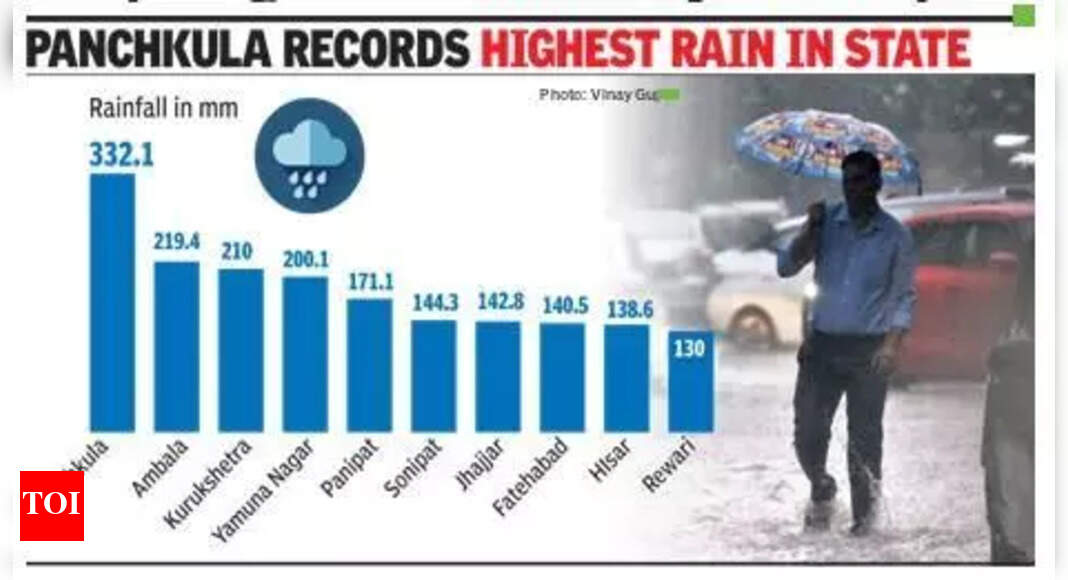

Gurgaon: Haryana has closed this monsoon season with its highest rainfall in three years. It has recorded a 70% surplus over the long-term average, according to IMD data.At 129.2 mm against a normal of 77.2 mm, 2025 stands out not just for the statewide numbers but also for the intensity of Sept showers that tipped the balance. In 2023, rainfall stood at 43mm (-44%) while in 2024, it was 105.7mm (37%). Officials at the meteorological centre noted that the late-season bursts were unusual. An IMD scientist said, "Most of the surplus came in the last fortnight of Sept, when several districts reco ...Read More >