
Stay updated with the latest Other news, articles, and insights from trusted sources. Explore in-depth coverage and expert analysis on Other topics.


Hyderabad: Owls are known for their silent flight, enabled by their skin and feathers dampening the sound by absorbing high- and low-frequency flight noise. Scientists have taken inspiration from the owl to develop a new soundproofing material, which can be used in cars and manufacturing facilities to reduce traffic and industrial noise. Published in ACS Applied Materials & Interfaces, the study -- Owl-Inspired Coupled Structure Nanofiber-Based Aerogels for Broadband Noise Reduction -- details a two-layer aerogel that mimics the structures inside owl feathers and skin to mitigate sound pollution. The new material claims to: Existing soundproofing materials absorb either high-frequency sounds (like squealing brakes) or low-frequency sounds (like the deep rumbling from a car engine). This warrants layers of multiple types of soundproofing materials to achieve full-spectrum noise control, which adds weight and bulk. To overcome this, researchers took inspiration from the owl, which uses its soft feathers and porous skin to remain whisper-quiet during flight, to develop a similarly versatile broadband sound absorber. Using a technique called emulsion-templated freeze-reconstruction, they froze droplets of hexane into a layer of soft material, the removal of which revealed a honeycomb-like pattern in the material. They added a second layer with silicon nanofibres to create a fibrous pattern, which turned into a light, porous two-layer aerogel that can mimic the structures in owl skin and feathers. The bottom porous layer resembles the bird's skin with microscopic cavities that cancel out low-frequency noise, whereas the top feather-inspired layer, made of fluffy nanofibers, dampens high-frequency sounds. The researchers believe this study paves the way for high-performance, lightweight, and durable sound-absorbing materials that can significantly reduce traffic and industrial noise pollution.


New Delhi, Jun 27 (PTI) The Delhi International Airport Ltd (DIAL) has informed the National Green Tribunal that data regarding the aircraft noise level at the Indira Gandhi International (IGI) Airport was easily accessible to all as it was being conveniently displayed on its website. DIAL operates the IGI Airport in the national capital. The green body was hearing a plea for compliance of the tribunal's direction in the matter over noise pollution at the IGI Airport due to landing and takeoff of aircraft at night. In an order dated May 26, made available recently, a bench of NGT Chairperso ...Read More >


Bengaluru: Deepavali nights were anything but quiet. Bengaluru recorded night-time noise levels touching 90 decibels in several areas -- nearly double the permissible limit, according to a report by Karnataka State Pollution Control Board (KSPCB).Noise levels spiked across residential neighbourhoods, revealing the city's festive soundscape remains far from compliant. Manual-monitoring stations recorded the highest night-time noise level at Sarjapur (90dB), followed by Indiranagar (73dB), Peenya (72dB), and Jayanagar (71dB). The Central Pollution Control Board's (CPCB) limit for residential are ...Read More >
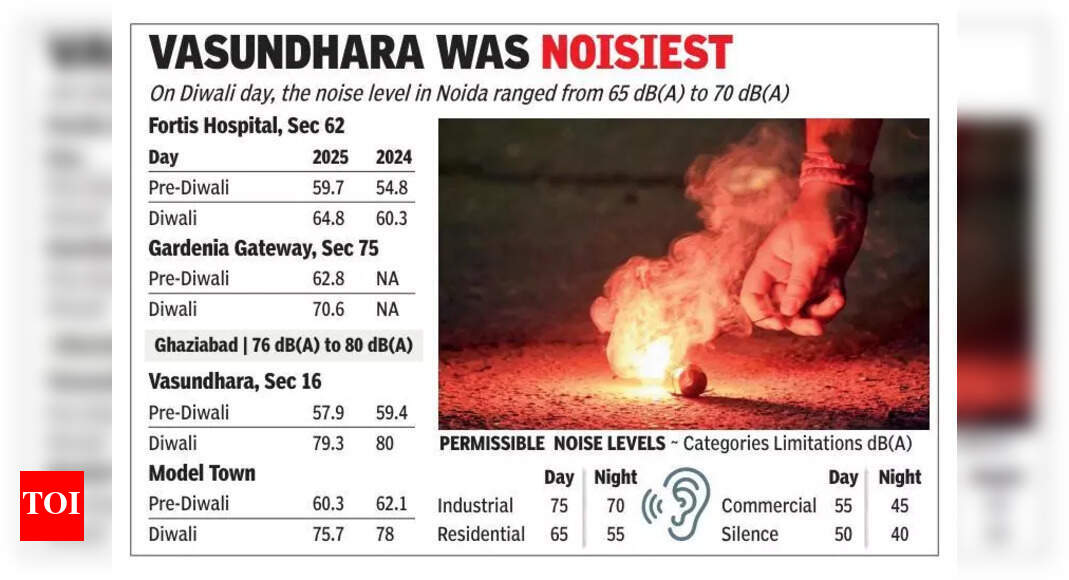
Noida: Noise pollution spiked this Diwali, with levels well exceeding permissible limits both in the city and in Ghaziabad. Residential areas were the worst hit, with a monitoring station in Ghaziabad's Vasundhara recording 79 dB(A), around 50% higher than the highest permissible limit of 55 dB(A).Silence zones, too, saw noise levels surge.In Noida, the silence zone near Fortis Hospital recorded 64.8 dB(A) in the period between 6pm and midnight on Oct 20. Being a busy area, it is anyway noisy. On Oct 13, for instance, it recorded 59.7 dB(A). The Diwali night noise level was the highest in the ...Read More >